
All‑on‑6 Full‑Arch Implant Rehabilitation
Oct 29, 2026
All‑on‑6 is a widely adopted screw‑retained full‑arch implant rehabilitation concept for completely edentulous patients, utilising six implants per arch to support a fixed definitive prosthesis. It sits alongside All‑on‑4 in the global full‑arch implant toolkit but targets cases where improved biomechanical distribution, shorter cantilevers and mechanical redundancy are clinical priorities. While All‑on‑4 remains popular for severely atrophic jaws that rely on tilted distal implants to avoid bone grafting, All‑on‑6 is generally selected when enough bone volume is available to place six fixtures evenly across the arch, commonly in a 2‑2‑2 distribution: two anterior, two premolar and two distal implant positions.
The core clinical advantage of All‑on‑6 is more uniform occlusal load sharing. With six anchorage points, bending stress on the framework, screw joints and surrounding bone is reduced compared to four‑implant designs with extended distal cantilevers. This makes it the preferred protocol for high‑risk patients: heavy bruxers, patients with natural opposing dentition, low‑density maxillary bone, or cases where the dentist plans a high‑strength monolithic zirconia full‑arch bridge. It also introduces implant redundancy; if one implant suffers delayed osseointegration or failure, the remaining five fixtures often have enough capacity to keep the full arch prosthesis stable without immediate remake, lowering catastrophic failure risk. Many clinicians also favour All‑on‑6 when the treatment goal includes functional second molars, which is harder to accomplish safely with long cantilevers on an All‑on‑4 setup.
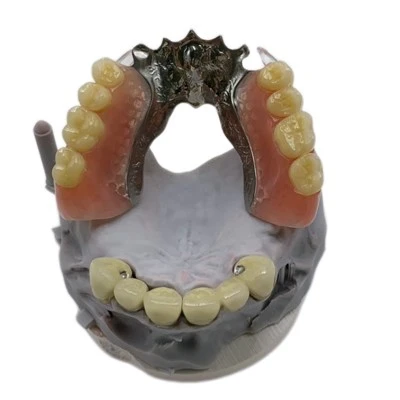
The typical workflow follows staged digital implant rehabilitation. After CBCT diagnosis and virtual implant planning, six implants are placed. Immediate provisional loading is possible when insertion torque and ISQ values meet stability thresholds, allowing a PMMA temporary full arch to be delivered on the same day or within a short healing window. Once osseointegration is complete, the lab receives implant‑level scan data, bite records, esthetic references and prescription notes to fabricate the final screw‑retained superstructure. Common final options include titanium bar frameworks veneered with composite or acrylic, full contour monolithic zirconia bridges, and hybrid prostheses with acrylic gingiva and composite teeth.
For dental technicians and OEM labs, several design rules are critical for All‑on‑6 success. Connector dimensions must be robust, especially between distal implant sites. Screw channel access must be planned for retrievability, and screw access holes are usually positioned on the occlusal or palatal/lingual surface to preserve buccal esthetics. Cantilever length is kept minimal, one of the main reasons dentists specify All‑on‑6. Gingival emergence profile, vestibular space and cleansability cannot be overlooked; full‑arch prostheses that block flossing and interproximal cleaning will trigger peri‑implant inflammation and marginal bone loss, even if the framework itself is mechanically sound. Occlusion requires careful articulation: balanced centric stops, controlled excursive guidance and avoidance of heavy lateral interferences are mandatory for bruxer cases.
Despite its biomechanical strengths, All‑on‑6 is not a universal upgrade over All‑on‑4. It demands sufficient posterior bone stock. In patients with severe maxillary sinus pneumatisation or extreme ridge resorption, achieving six stable implant positions may require sinus lifts, ridge augmentation or other grafting procedures, raising surgical cost, complexity and treatment timeline. It also carries higher material and implant component costs compared to All‑on‑4. For that reason, many US, European and African dentists use a case‑by‑case selection strategy: All‑on‑4 for atrophic arches and All‑on‑6 for bone‑adequate, high‑occlusal‑force rehabilitations.
Complications seen in All‑on‑6 cases are mostly framework fracture, veneer chipping, screw loosening, peri‑implant mucositis and poor marginal adaptation. Most lab‑related failures trace back to insufficient framework cross‑section, inaccurate multi‑unit abutment positioning, misaligned scan bodies, or occlusal overload from uncalibrated digital articulation. Clear lab prescription communication is essential: clients need to specify whether they require monolithic zirconia, titanium‑acrylic hybrid, screw‑channel location, gingival porcelain/composite characterization, and bruxism modifications.
Within the global outsourced dental supply chain, All‑on‑6 has become a high‑volume premium implant category for Shenzhen‑Dongguan OEM factories. It fits well within digital scan‑to‑mill workflows and often runs alongside All‑on‑4, implant overdentures and fixed implant bridges. Export labs must maintain full traceability for titanium alloys, zirconia blanks and veneering materials; EU‑bound All‑on‑6 superstructures fall under MDR controls and require ISO 13485 documentation, material certificates, risk files and process validation records.
Industry trends show that All‑on‑6 demand continues rising as more prosthodontists shift toward conservative, low‑cantilever full‑arch designs. It complements the hybrid and digital denture trends covered earlier: many clinics combine fixed All‑on‑6 rehabilitations for suitable edentulous patients while keeping implant overdentures and conventional acrylic dentures for those with poorer bone, budget constraints or unfavourable jaw relationships.
In summary, All‑on‑6 is a predictable, load‑friendly full‑arch implant protocol built around six evenly distributed implants. It excels where biomechanical safety and long‑term serviceability are prioritized, but it remains anatomy‑dependent. For offshore dental labs, mastering accurate implant scan capture, rigid framework design, retrievable screw planning and occlusal validation is essential to deliver consistent, clinic‑trusted All‑on‑6 superstructures.